Our party was stealthily approaching a fortress embedded on the side of a mountain. As we were about to rush the fortified gate, a dragon flew out of a hidden space high above us. Before the GM could finish narrating, Gecko, our ranger, declared he was firing a crossbow bolt at the dragon.
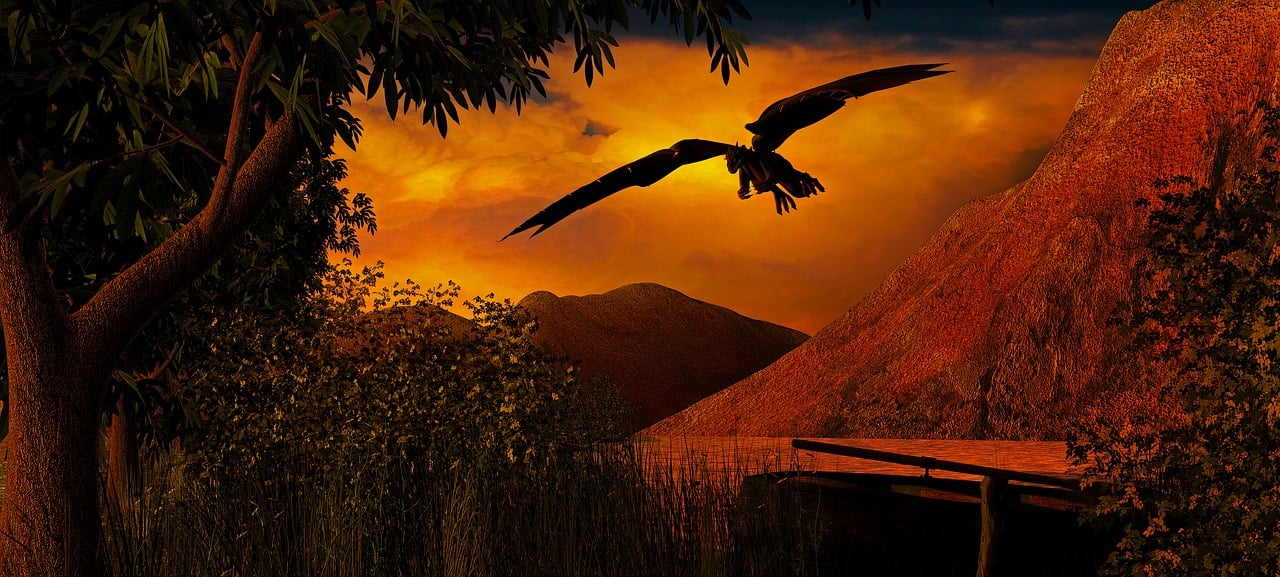
See how the dragon is flying away? Yeah, that’s what was supposed to happen. (Source)
This was an unpopular decision with the rest of the party. We had just encountered a different dragon in the previous session which had killed two party members. We were also travelling along a steep and narrow path without any shelter. The GM considered just having the arrow miss and the dragon fly away. According to the campaign book, the dragon was supposed to fly away, not noticing us. However, the attack was declared immediately after the dragon was sighted. Rash actions should have consequences. The GM ruled that the attack would proceed and the player should roll.
Maybe we’d be lucky and the bolt would miss and the dragon would keep flying away.
Gecko rolled a hit but dealt a pitiful amount of damage to the dragon. The dragon immediately banked in the air to attack.
About half the party won initiative on the dragon and scattered, two finding some safety by Misty Stepping into the fortress.
The dragon’s first attack was brutal with multiple members bearing the brunt of a breath attack and, more frighteningly, half the party mind controlled. Undeterred, Gecko kept up the fight, firing arrow after arrow, while others managed to find defensive positions.
The dragon ordered the mind controlled members to kill Gecko. However, the design of the fortress was our saviour, as the two members that had Misty Stepped into the fortress (and who had both succumbed to mind control) now needed to find an exit but neither knew where the exit was nor how to open the gates.
The party started to rally, peltering the dragon with ranged attacks. Frustrated, the dragon swooped down and grabbed Gecko and another party member, Karen, flying them both away from the mountain, intending to drop them to their death.
Karen’s twin summoned an air elemental. Summoning at maximum range, the elemental was able to grapple Karen, but lacked the action to also grapple Gecko. When the dragon’s next turn came, the dragon dropped Gecko and Karen. The elemental’s grapple saved Karen from the fall.
There was no one to catch Gecko. Gecko struck the dragon one last time as gravity took over. As he plummeted to the gorge below, he cried out one last message to the party: “Fireball!”.
Heavily wounded, the dragon flew back to its cave. The tenacious members throw everything they can at the retreating dragon, killing it just prior to it finding safety.
Actions had consequences. Gecko did pay for a foolish attack on a dragon with his life. But consequences also came for the GM. The dragon was supposed to be a recurring threat. The dragon’s attacks were supposed to rewrite the geography of the land. Consequently, in his decision to use a stick, the gamemaster now had much to rewrite.
The GM lost a recurring villain, but we gained a legendary story. If your players choose the stick over the carrot, let them. Rewrite the geography. Rewrite the villain. The consequences make the game real. And when a player needs to make a new 5e character, have them consider a custom subclass from our collection!
