As gamemasters, we’ve had to run combat with all sorts of monsters, often with very unusual powers. Game publishers typically use standardized designs for showcasing monsters, commonly called a stat block. The information design of the stat block can be the difference between straight-forward combat encounters and aggravating, pause-the-action-while-I-look-up-a-rule sessions. In this article, three of Owlette Publications’ game masters look back on four decades of stat block examples and debate what works and what doesn’t.
Note: The original books include pictures for each monster. Depending on the source layout, we have excluded the artwork to concentrate on the stat blocks.
Monster Manual (TSR, AD&D, 1st Edition) (1979)
The 1st edition Monster Manual for AD&D was a chance to greatly clean up and enhance the stat blocks in Chainmail, the White Box, and other early editions. TSR had access to better typesetting systems as well.
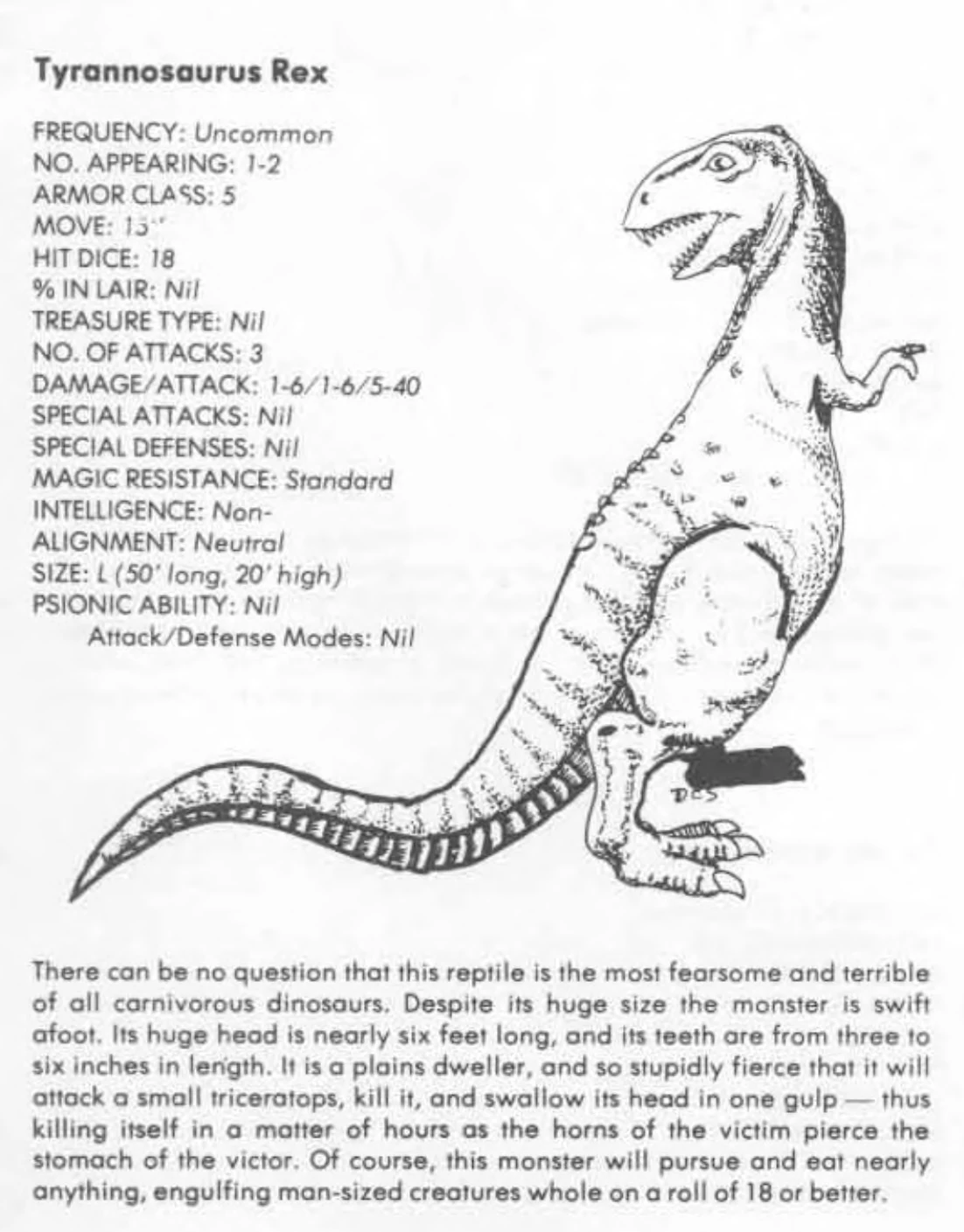
Jeffrey: Organizationally, it is unclear why the stats are organized in this order. The background and lore details (e.g. Frequency, Treasure Type) are mixed between combat specific stats like Armor Class and No. Of Attacks. The game master is expected to roll hit points based on hit dice (18 dice, btw) which will be the norm for many years. The description also places a key combat detail–the engulfing man-sized creatures on a 18 or better–at the very end of the paragraph that is otherwise descriptive.
Justin: Yeah, the mix of assorted stats is a bit hard to read. So is all of the use of the word “nil”. I also really don’t like the math required to take “5-40” and convert it into “roll 5d8”. And, come on - “[…] it will attack a small triceratops, kill it, and swallow its head in one gulp”, yet you need to roll an 18 or better to eat a human? But I’m honestly just happy to see Tyrannosaurus Rex represented so early on here.
Andy: The flavor text generates a lot of ambiguity on how to actually run the TRex. He wins, swallows an enemy, and dies from horns piercing its stomach? Why not just feed it a ball of spears and steaks so it kills itself. I mean, it has an intelligence of non- afterall. I do appreciate that they took time to create a flavor text though and thought of the monsters as more than just a spreadsheet.
Monstrous Compendium, Volume 1 (TSR, AD&D, 2nd Edition) (1989)
For the 2nd edition of AD&D, TSR used a full page for each monster, adding many background and lore details. Monsters were initially published in a binder and game masters could add new monsters via a hole punch. Later, the Monstrous Manual compiled them into a hardbound book.
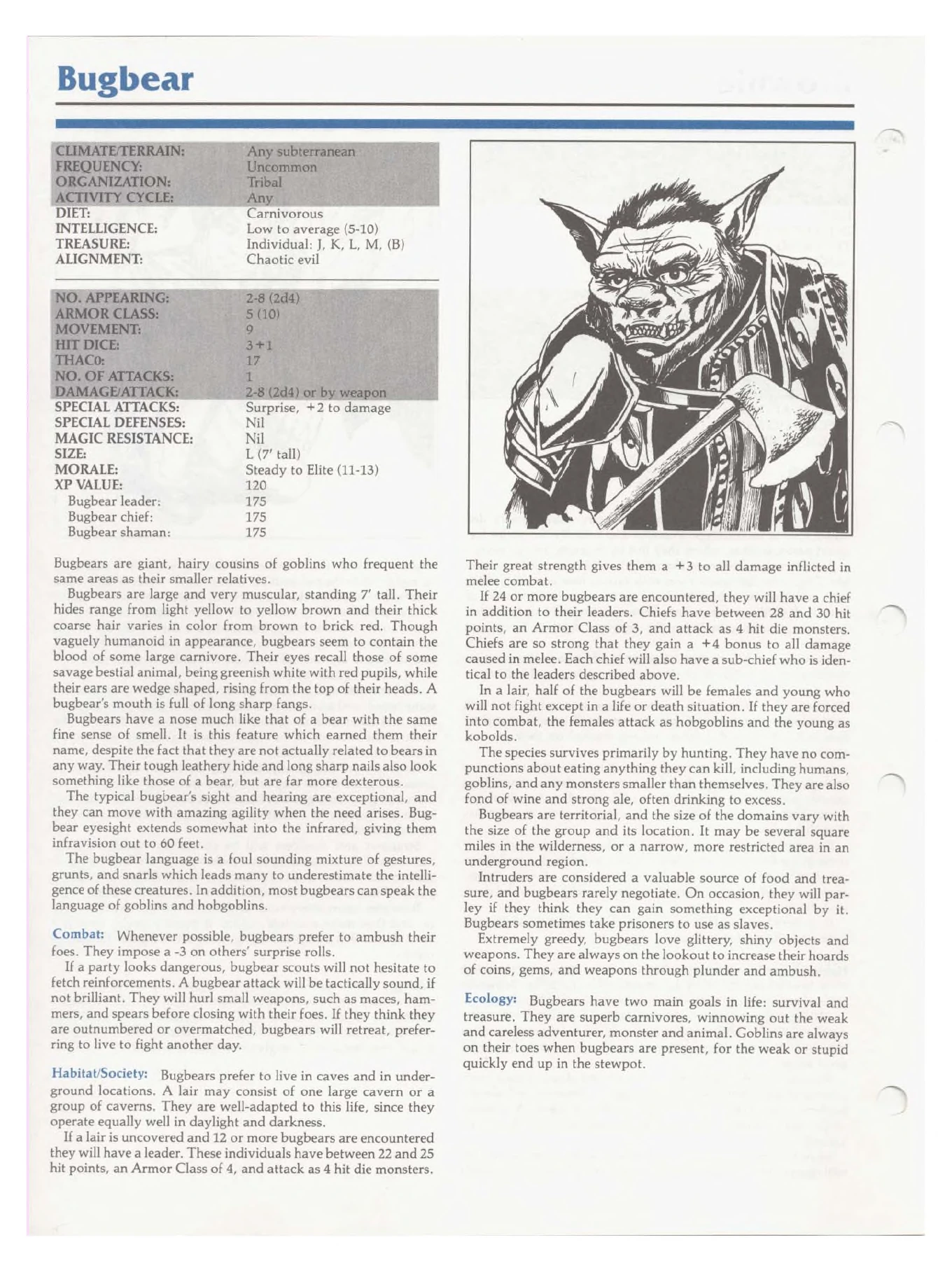
Justin: When I’m deciding which monster to raise fresh chaos with at my gaming table, I want to feel like I’ve read a novel before I make a decision. This iteration accomplishes my innermost desires. Likes: “2-8 (2d4)”; continued use of “nil” because I’ve changed my mind mid-blog and I’m on board now; pretty good improvements on the arrangement of the stats. Dislikes: Still a lack of color; Movement of 9 feels overly precise; what on earth is a THAC0? Is that a D&D taco? I can see the improvement between the last one and this one.
Jeffrey: I grew up with 2nd edition, so this set my level expectations. Monsters were situated in a world and given motivations and tendencies. Although THAC0 was often hated, I found it an efficient way to eliminate the large to-hit tables found in earlier additions. But you are right there is often a dependency on other books and tables, such as interpreting the treasure values. Also, typical values (such as hit points) are not presented, so using a monster requires some prep work.
Andy: I disagree in that I really don’t want to read a novel before leveraging a monster in a game. My players are often just turning a corner, climbing down a random ladder, or diving into a hidden cave and I need to pull monsters quickly so we aren’t just killing cultists and kobolds all day long. Some standout items that I really appreciate: morale (we don’t retreat enemies nearly enough in D&D anymore as most things don’t actually want to fight to the death), intelligence ranges encouraging diversity within the enemies, and the classic treasure table. I love rolling on a treasure table and having to adapt my game just as the players do when they find some good loot.
Ye Booke of Monstres II (Chaosium, Call of Cthulhu, 5th Edition) (1995)
Ye Booke of Monstres was a sourcebook for Call of Cthulhu. Monster entries are presented similarly to the core book.
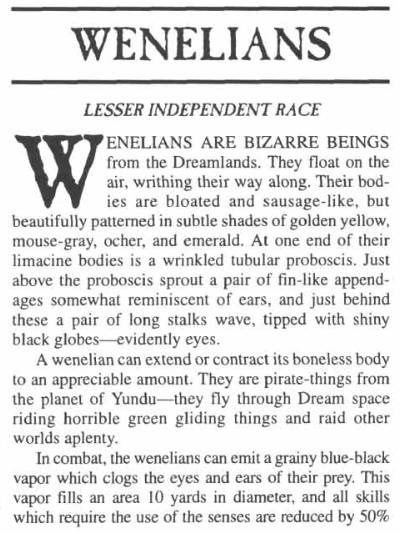
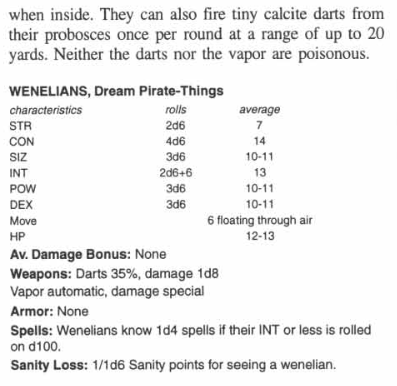
Justin: I’m happy we fully moved away from that “2-8, 1-6, 5-40” nonsense. And we have our first appearance of averages, which is helpful for the hurried GM. I’m a bit (pleasantly) surprised to see a fun monster-creation mechanic for the GM, in that they can potentially choose 1d4 spells that the monster knows. I’m even more surprised that the block does not limit which spells it knows.
Jeffrey: The paragraphs with combat-specific rules are at least prefixed with “In combat” to aid with skimming. However, the sentence “Neither the darts nor the vapor are poisonous.” is noise as there isn’t any reason to believe they are poison. Rolling for spells requires prep, particularly if you also need to figure out how those spells might impact an encounter. I remember RPGA adventures (which were meant to be run at conventions with only a couple of hours of prep) were applauded as specifying all spells for spellcasters ahead of time, including the spell caster’s tactics.
Dragonlance: 5th Age (TSR, Fifth Age) (1996)
Fifth Age separated the stat blocks from monster descriptions. There were multiple tables organized like this for various groupings of monsters.
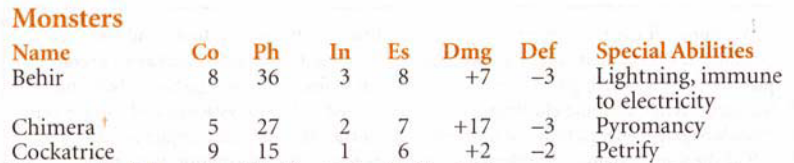
Jeffrey: I like when systems allow compact representations of stats (such as in Traveller), but I dislike when stats are separated from the monster descriptions. It causes more page flipping and encourages readers to lose their place, especially if the table is long. This table does not include any scoring of rows to help the reader’s eye stay aligned.
Andy: The Dragonlance 5th Age came out long before we had koboldfightclub or dndbeyond. There was no good way to understand at a quick glance the level and might of a monster. This was a great way to consolidate a massive amount of information to find an appropriate challenge for your players and then look up their specific blocks to get additional details and flavor as needed.
Justin: I do like the idea of having a “quick reference guide” of sorts like this. I think this stat block definitely flipped the “stat blocks have too much info” sentiment on its head, and not in a particularly good way. I’m sure I could eventually memorize what each of those header abbreviations stands for, but I just don’t want to. Also: my headcanon is that “Ph” tells us what the acidity of the monster is.
Atomic Horror, 2nd Edition (Steve Jackson Games, GURPS) (2001)
GURP Atomic Horror is a supplement for running 1950s/Cold War science fiction games. GURPS is a universal, point-based game system.
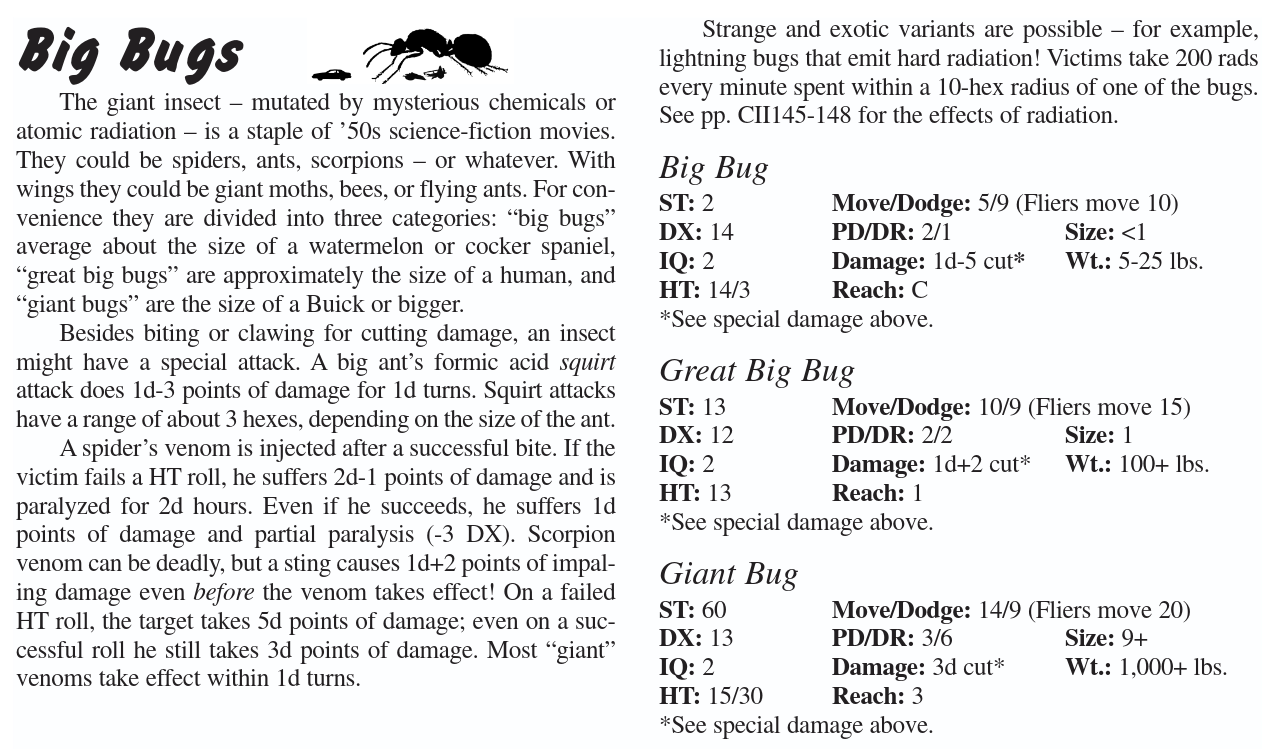
Justin: This one is making me back off of my “read a novel first” position from earlier. I don’t like how SEVERAL paragraphs here would need to be referenced mid-battle. I don’t have time to re-read that every time I wanna attack! Give me a list of things I can do or need to follow near the stat block, even if it’s repetitive. It’s like those asterisks pointing to the prose above are laughing at my pain.
Jeffrey: This is an unusual entry because it is for a class of monsters, rather than specific ones. Variants like spiders, scorpions, and ants are all addressed in the text, without any real delimiters. The entry could use another table that lists variants and special attacks, rather than three paragraphs of mixed ideas.
HERO System Bestiary, 5th Edition (Hero Games, HERO System) (2002)
The HERO System is a highly flexible point-based system. Most people encountered it through its super-hero setting, Champions.
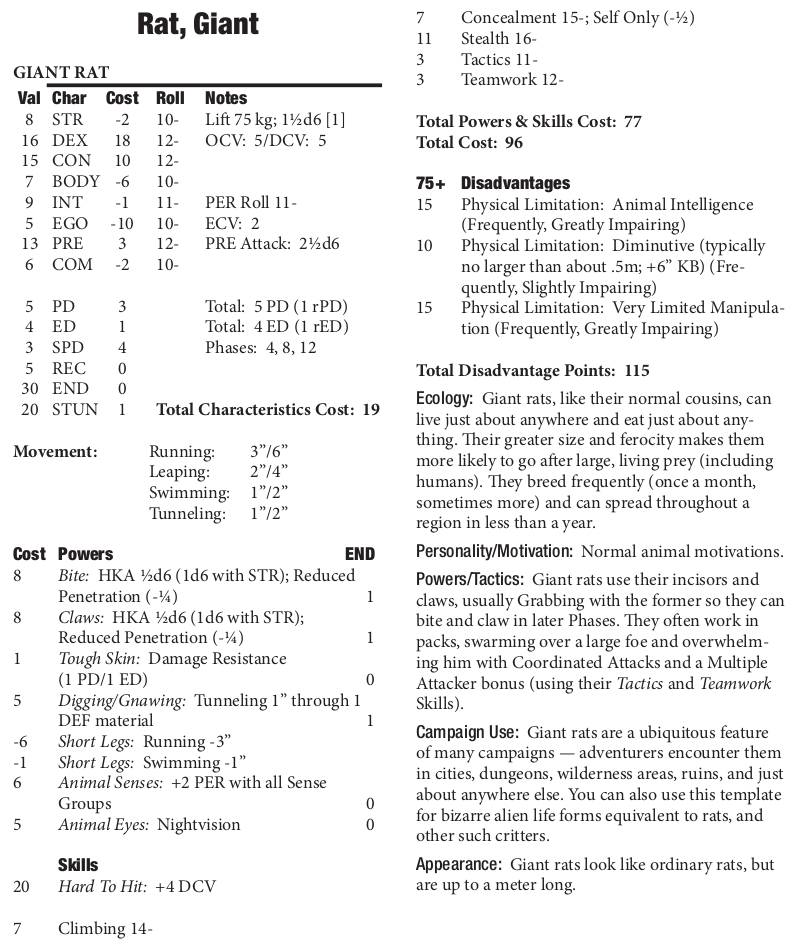
Jeffrey: This is a separate concern, but I think this example illustrates how much work is required in point-based systems to build opponents.
Justin: There is absolutely zero chance that I would look at this page and think to myself, “Oh yeah, I’m definitely playing this game.” I would immediately tag out to go play something on the PS2.
Andy: I’m torn. Reading this as a player makes me incredibly excited to sit down with spreadsheets and create multiple theories for how I could create a variety of super heroes. Even taking hits and weaknesses to create super advantages and flush out a more robust hero that is dynamic and exciting to play. This inevitably leads to massive replayability as well. Then the GM in me winces in pain as every single monster is far far too complicated to run. I don’t have the time anymore to build out this level of detail in my worlds and I would refuse to run this game (but man would I be excited to play in it!).
Monster Manual (Wizards of the Coast, D&D, 5th Edition) (2024)
Dungeons & Dragons updated their stat blocks for the 2024 edition. WoTC describes how the stat blocks changed from the 2014 edition in this article. This example is taken from D&D Beyond.
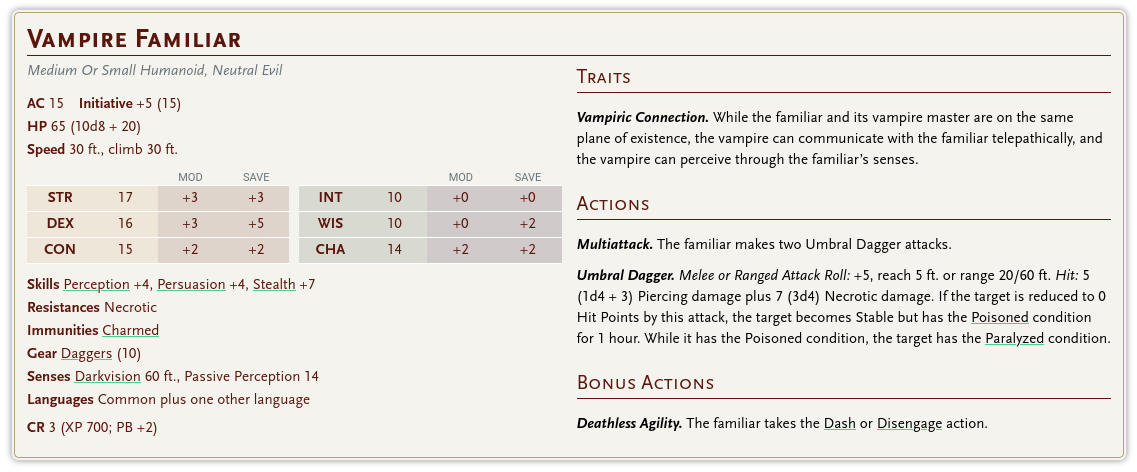
Andy: Clean, condensed, and gives me everything I need to know if it is an appropriate level and challenge for my
players. Although I’m not a fan at all of the CR system. While very comfortable with this, I think there are
significant misses. The stat blocks have lost the details and the tactics on how to effectively play the monster.
There is no morale, there is no underlying incentive or strategy, it is simply “go, fight, die”. There are also
no details or key notes about the monster here. I find many of the monsters often blend together as just that,
monsters. Doesn’t matter if it is a vampire familiar or a gnoll, it’s a hit point sponge to be slowly whittled down.
Jeffrey: I agree that this presentation is sterile, although I understand WotC sees this as a way to encourage people to buy the books which contain more background material. These entries heavily use standardized terminology such as “Poisoned” or “Paralyzed” condition, and “Dash” and “Disengage”. An advantage is that these terms can be hyperlinked to their definition (or at least easily referenced), although it diminishes the variety of say, poisons in earlier editions which could reproduce any Agatha Christie mystery.
Justin: As a person who got started with TTRPGs in 5e, this feels like home. It’s hard to remove that bias. The faint-but-helpful color scheme! The actual sections for various components of the block! The skimmable nature of it so you can quickly find what you’re looking for! Though, one nit: 10 daggers is not nearly enough daggers.
